Designer in the loop
Anyone can prompt an AI for an output now.
A user interface. A set of personas. A service strategy. A 10-page paper. Ask, and a few seconds later you’ll have something that looks finished.
I think that’s a good thing. The lower the barrier for anyone to turn their ideas into something, the better. In that sense, everyone is a designer, and always has been. I’m a big advocate for ideas coming from everyone, and for the value of diverse thinking. In workshops, I encourage people who say they can’t sketch: words and boxes are sketches too.
So I’m not lobbying to stop any of that.
But when outputs come this cheap, it’s easy to mistake them for design that’s done. The best designers know: it’s never been about outputs. It’s about outcomes.
Why AI feels like a threat to designers
A lot of designers are worried AI is coming for their jobs. I understand why.
The people we work with are going to use it. If a stakeholder can get something that looks like a design in minutes, rather than waiting for a team of designers, why wouldn’t they? Why not skip the design process altogether, and cut the designer out of the loop?
It’s a fair question. If you boil product and interaction design down to making pictures of websites, AI can probably do that quite quickly.
But that’s not the job. It’s never been the job.
So can they do it all themselves? I’ve decided they can’t. Not because only designers are allowed to design, but because of what gets skipped: the critical thinking that design brings to a team.
Designers have always had to adapt
We’ve been here before, in smaller ways.
Once upon a time it was Macromedia Fireworks. Then Photoshop, Sketch, Figma, and now prototyping directly in code.
Every new tool changed how we work. None of them changed why.
A designer’s greatest skill is being able to adapt. That’s what gives me confidence now. Not that AI will leave design alone, but that designers have always worked out what a new tool is for, and what it isn’t. Our value in teams doesn’t disappear. It evolves.
How I’m experimenting with AI
I’m not writing this from the sidelines. I’ve been experimenting with AI for a few years, and so has my team. We’ve agreed principles and guardrails for what we will and won’t use it for. In particular, we don’t use it to generate user interfaces or graphic design that could feel imitative or derivative of other people’s work.
Most recently, I wanted to see what was possible beyond the basic generation of assets. So I stress-tested it against an end-to-end design process. What would it get right? What would it get wrong? How much could it support a team doing real-world work? And how much would it simply make up, convincingly enough to catch people out?
The briefs came from our design team away day on 30 September. We split into multidisciplinary teams and tackled three related briefs about women’s urinary tract infections (UTIs).
I took one of those briefs to experiment with AI: a patient sharing their history of UTIs with pharmacists and GPs. Crucially, I didn’t just prompt “give me a solution to this brief”. That would be lazy. It’s also the biggest risk I see when anyone uses AI.
I started by framing the problem to be solved: what I already knew, and the why. As designers, we don’t simply rely on the brief. We challenge it, pick it apart and look for the opportunities in it. Doing that here shifted the problem. It wasn’t really about the patient remembering their history. It was about showing it to a rushed GP in a way they’d believe. Proto-personas for everyone involved, from out-of-hours clinicians to pharmacists, set out what each of them needs before they’ll act on what they’re shown. From those came a set of design principles: a framework to guide every decision that followed, so each one was deliberate.
Then three genuinely different ideas, scored against those principles so the choice was traceable rather than a matter of taste. A prototype built with the NHS Design System so nothing was borrowed. An accessibility statement, written from what was actually built and used straight away to improve the prototype. And a strategy for what to validate first, and with whom.
Each step fed the next, and I made sure it kept track. Every stage includes a short narrative on how it shaped what came after, and messages to socialise with a real team at that point, to maintain shared understanding.
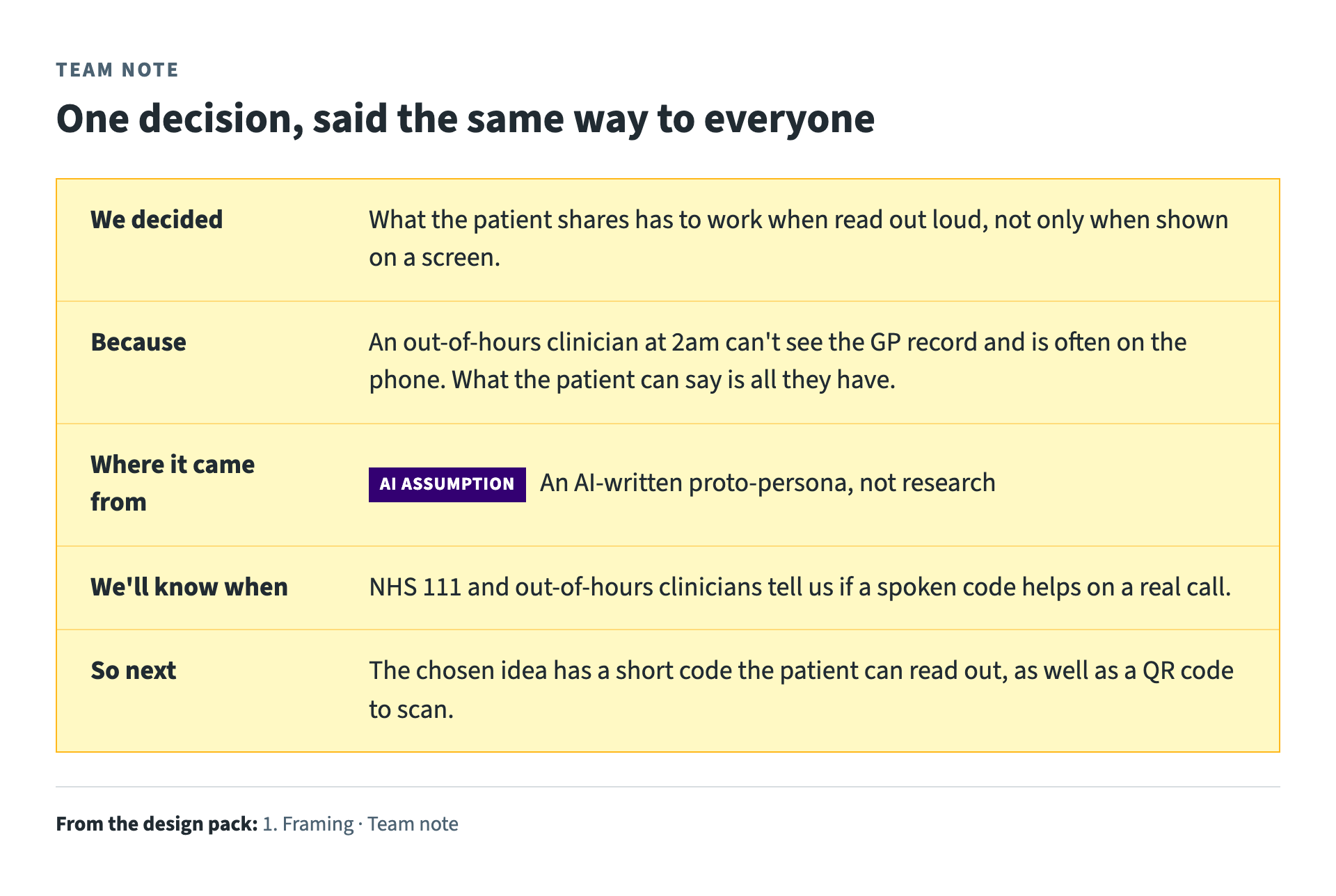
Transparent traceability of decisions, so everyone has a shared understanding.
Then I audited the whole chain, tagging every claim as verified, desk knowledge, assumption or illustrative. That’s provenance: being clear where each claim came from. Has it been checked? Is it drawn from existing knowledge? Is it something we believe? Or was it made up to make the design look legit?
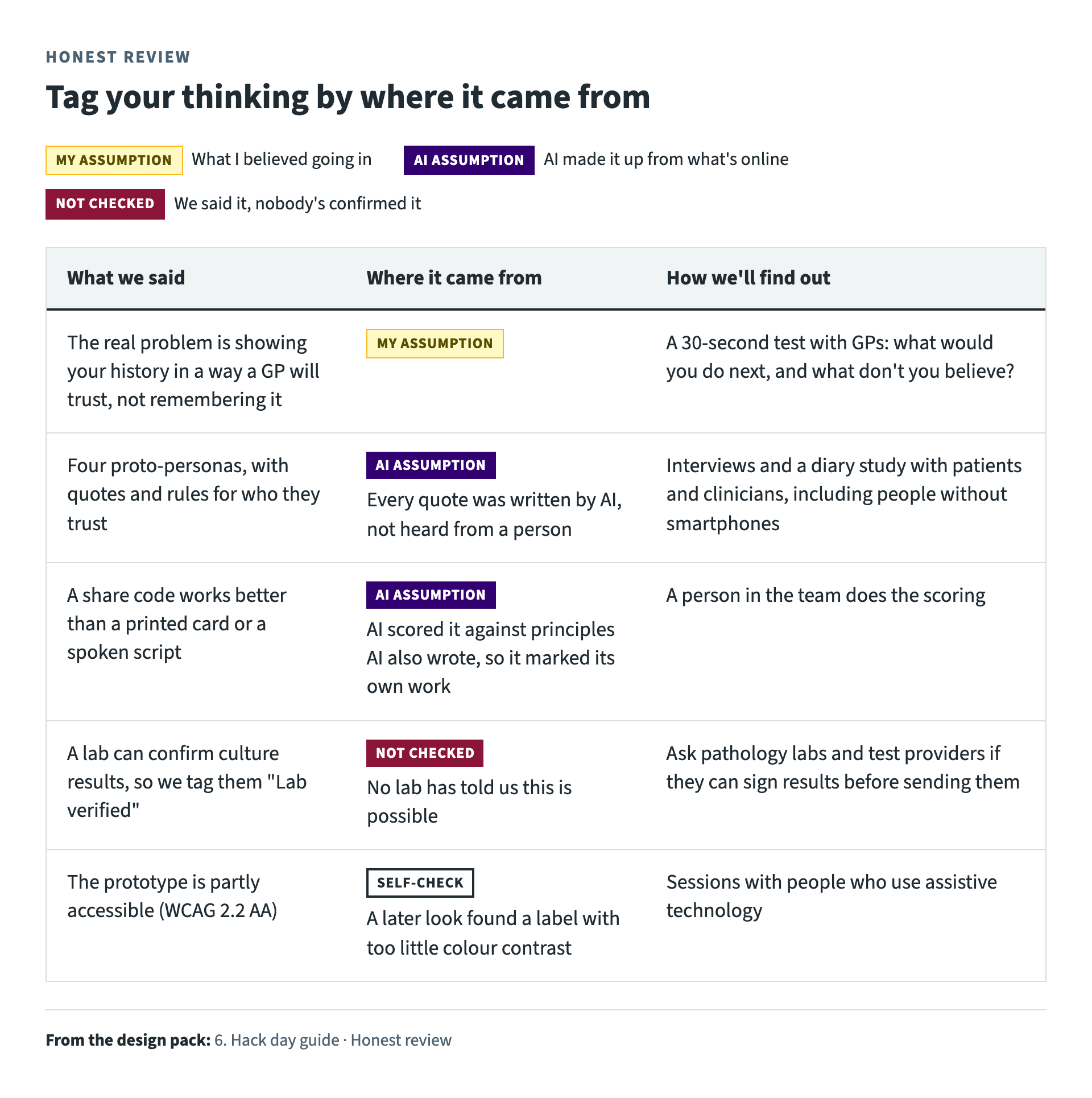
Most of what looked like progress was assumption. Tagging it doesn't make it wrong. It shows what to test first.
Everything looked finished: the personas, the prototype, the strategy. None of it had been tested with real people.
That’s fine for a first pass, as long as you’re honest about it. What matters is calling it out, by declaring the provenance of every piece of data, evidence and decision.
I didn’t just use AI to give me a solution or a pretty picture. I used it as part of a deep design co-creation process, albeit with a computer.
I was impressed by how far it got. I’ll share more detail at some point. But I’ve only done it once, and not in a real team context. Putting it out into the world as a finished thing would be the very thing I’m arguing against: prompt, response, done.
The real risk is what people act on
What the shortcut gets you is an output. It may well look plausible.
And that’s the real risk. It’s bigger than who gets to design. AI output is so convincing that people act on it. A prototype gets mistaken for a decision. A confident summary gets treated as fact. Just because it looks right doesn’t mean it is.
So someone has to ask. Is it solving the right problem? Is it solving the problem right? Is it built on evidence, or on something that only sounds like evidence? Did anyone think critically about it, or did that step get skipped? Who does it leave out? And who else understands it, or was it made in a silo?
Those are design questions. Answering them is the job.
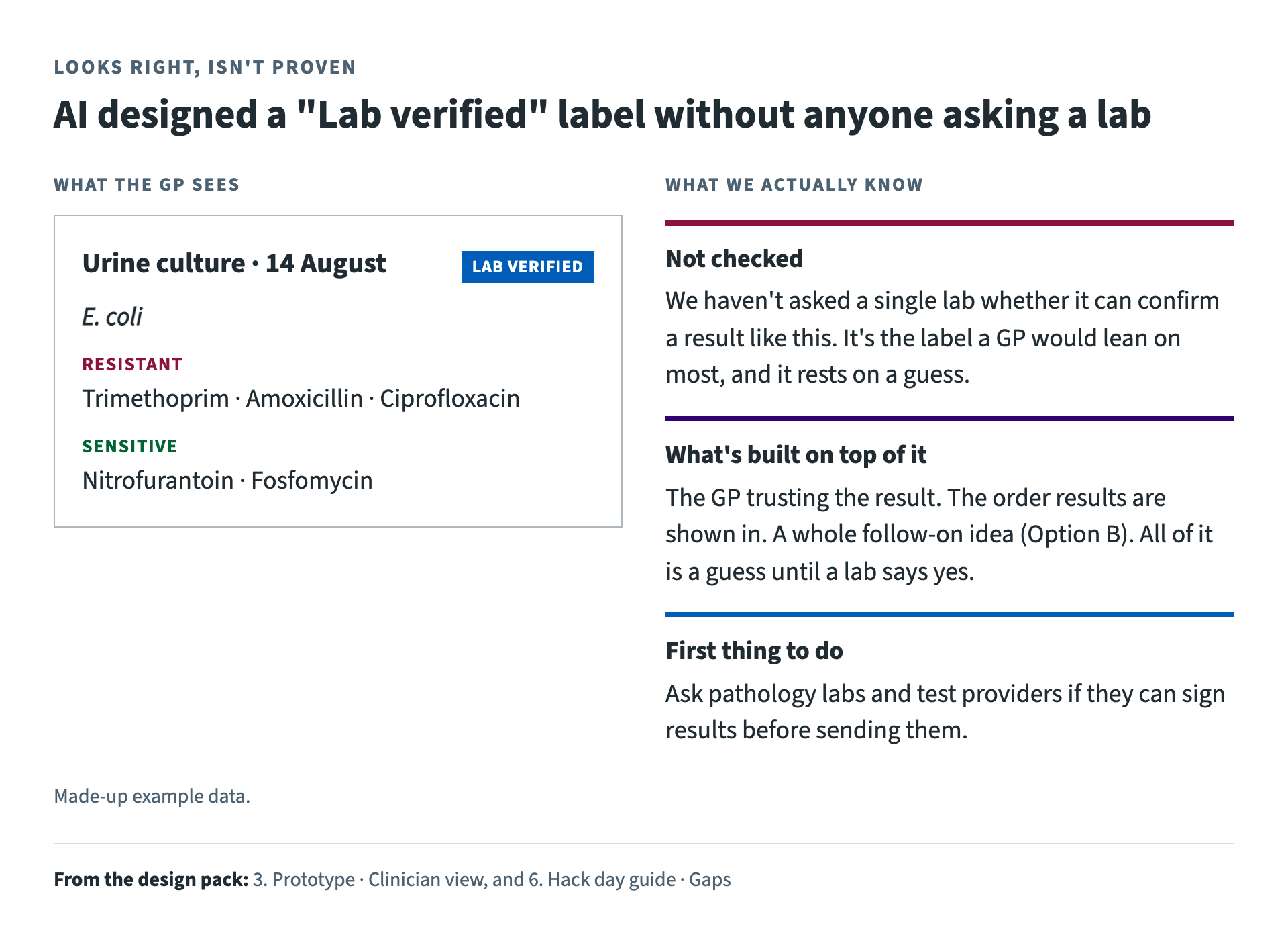
It took seconds to design, and it's probably the label a GP would trust most. Nobody has checked whether it’s feasible.
People talk about keeping a human in the loop with AI. I’m not saying everything has to go through a designer. But the critical thinking that design brings to a team has to stay in the loop, and that’s where designers earn their place.
They start with outcomes. Before anything is generated, a designer makes sure the whole team knows what problem we’re solving, for whom, and how we’ll know if it’s worked.
They think critically about what comes back. Ask an AI for personas and every quote in them will be written, not heard. A designer keeps the thinking traceable, and treats all of it as an assumption or a hypothesis to test in delivery, until it’s validated or disproven with real people.
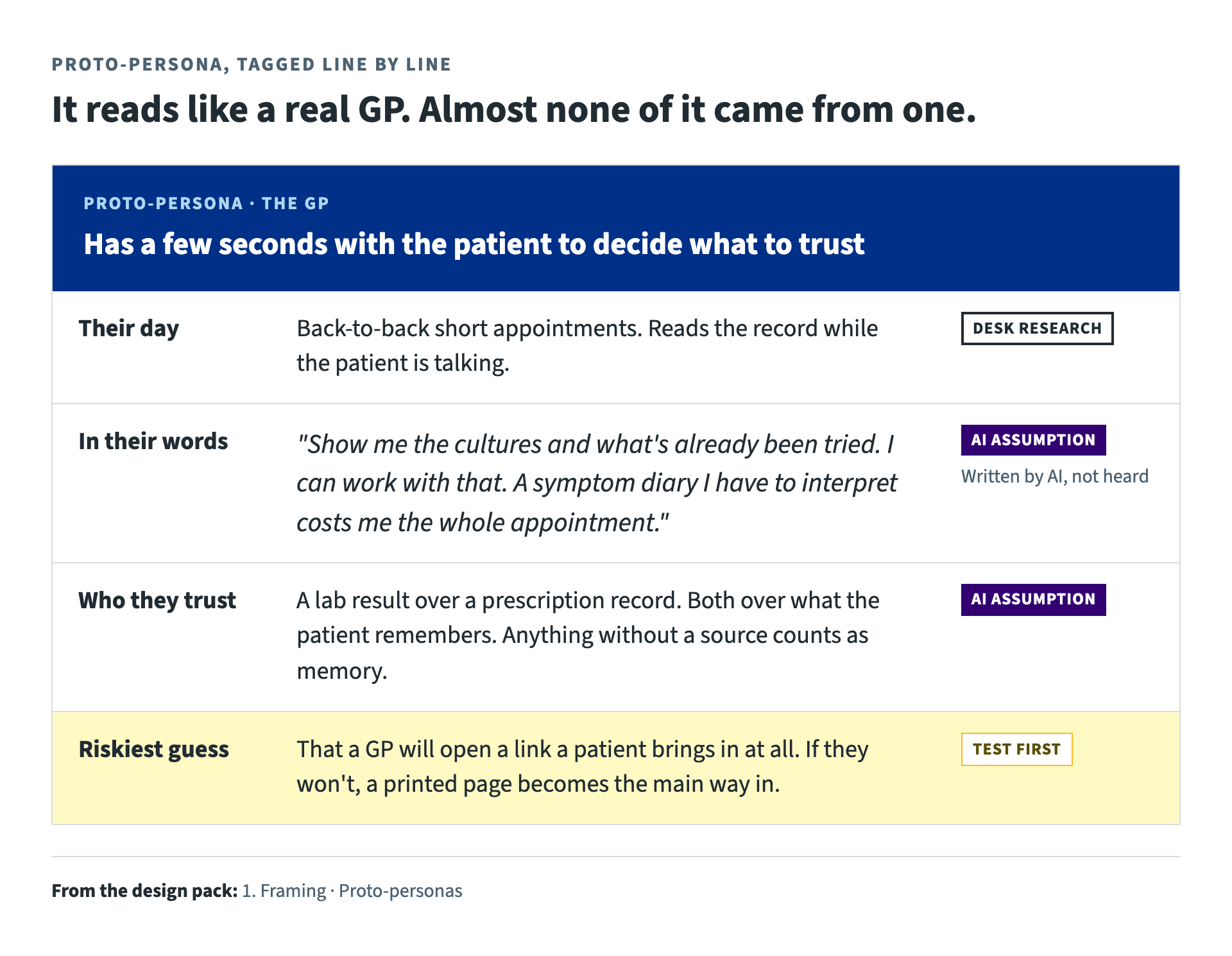
It reads like a real person, and that's the risk. It's useful for starting a conversation, but not as evidence.
They look for the edges. Generated work drifts towards the average. A designer asks whose needs we’re not meeting, because those people are often the hardest to reach, and their needs the most interesting problems to solve.
They align humans. Getting a GP, a pharmacist and a patient to agree on what problem we’re solving doesn’t happen one-on-one with a computer. Designers create shared understanding, communicate it, and inject enough certainty that a whole team can make progress.
And they’re connoisseurs. Over years of experience, designers build a sense of what good looks like, and what bad looks like, mostly from getting it wrong. The best connoisseurs are connoisseurs for a reason: they have a deep understanding of users, of the problem, and of the product and technical context. That’s what lets them steer the back and forth of prompting and iterating towards something worth having. And it’s what lets them see what’s missing when something only looks finished.
I see a lot of people saying roles are changing and designers need to become prompt designers. I don’t agree. What you put into the machine is part of it, sure. But the more critical end is what comes out.
None of this is new. It’s always been the job. AI just makes it easier to skip. That’s the unintended consequence we all need to be aware of.
Using AI purposefully, as a multiplier
So this is also a message to designers. If you use AI, use it purposefully. Be pragmatic about it, not dogmatic.
Used well, it becomes a multiplier rather than a replacement. It accelerates the skills you already have instead of standing in for them.
Just be open about it. Using AI quietly, on your own, is how silos start. Openness is where shared understanding starts. So own it and say it plainly. Yes, we’re using AI. This is how.
That’s why I’m excited by the idea of using it in a structured and repeatable way. There’ll be a process. We can go through it together.
These are strong opinions, loosely held. I’m still experimenting, and I expect my position to change. Adapting is what designers do.
But I’m sure of this much. Anyone can make an output, and I hope more people do. Outcomes still need someone in the loop thinking critically.
So don’t be afraid of AI. But don’t be lazy with it either.
Be the designer in the loop.